Aunt
Aunt

She was sick and nowhere to go, Mother said. So
she came to us, her brother's home. Most of her days
she sat in her room, looking out the door at us, little kids
in our room looking at her thin face, with wry smile, for
hugs were not allowed; only hello and blown kiss.

Wearing her shame, like a thick, bruised skin,
the possibility of spreading the disease to the loved ones,
she wished her days were brief; she would wait for the day
she could rest, beneath the snow of the backyard mound.

After she had gone, Mother came down with the aunt's
breath and fever; worried for us; blamed the aunt's gift that
would bring the doom home; we all were wrapped in her shadow.

To this day, we siblings have been free of the aunt's
feverish breath; wish it would stay that way, like the days
of the vanished wind. Aunt's ghost smiles like the olden days,
when she could play with us kids.

©Byung A. Fallgren
Drifting
Drifting
Olivia Ward Bush-Bank

And now sun is tinted splendor sank,
   The west was all aglow with crimson light;
The bay seemed like a sheet of burnished gold,
   Its waters glistened with such radiant bright.

At anchor lay the yachts with snow white sails,
   Outlined against the glowing, rose-hued sky,
No ripple stirred the winter's calm repose
   Save when a tiny craft sped lightly by,

Our boat was drifting slowly, gently round,
   To rest secure till evening shadows fell;
No sound disturbed the stillness of the air,
   Saved the soft chiming of the vesper bell.

Yes, drifting, drifting; and I thought that life,
   When nearing death, is like the sunset sky;
And death is but the slow, sure drifting in
   To rest far more securely, by and by.

Then let me drift along the bay of time,
   Till my last sun shall set in glowing light;
Let me cast anchor where no shadow fall,
   Forever moored within heaven's harbor bright.

Olivia Ward Bush-Bank was born on 2-27-1869,
in Sang Harbor New York. A poet, short story writer,
journalist, she was the author of Original Poems
(Louis A. Basinet, 1899), and more. She died on
4-8-1944.
The Weekly Avocet
My three Haiku are published in this week's Weekly Avocet. Thank you, Charles, Vivian, and Valerie for
taking the pieces. --Byung A.
Winter Haiku
My three haiku are published in The Weekly Avocet #536.

Thank you, Charles, Vivian, and Valerie for taking the pieces.
Trees at Night
Trees at Night
 Helen Johnson

Slim Sentinels
Stretching lacy arms
About a slumbrous moon;
Black quivering
Silhouettes,
Tremulous,
Stenciled on the petal
Of blue bell;
Ink sputtered
On a robin's breast;
The jagged rent
Of mountains
Reflected in a
Stilly sleeping lake;
Fragile pinnacles
Of fairy castles;
Torn webs of shadows;
And
Printed 'gainst the sky--
The trembling beauty
Of an urgent pine.

Helen Johnson was a poet of the Harlem Renaissance movement.
March
March

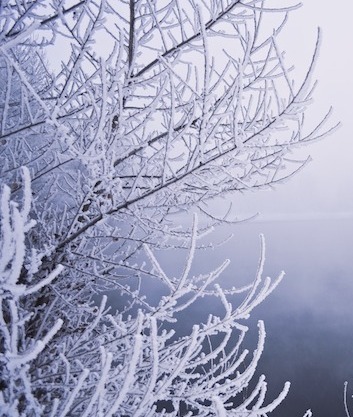
reluctant spring
watches
from the distance
like hesitant
neighbor's cat

the broken tulip
by the deer
last spring
still dreams
in the frozen soil

©Byung A. Fallgren
The Weekly Avocet
Two Countries
Two Countries
Naomi Shihab Nye--1952--

Skin remembers how long the years grow
when skin is not touched, a gray tunnel
of singleness, feather lost from the tail
of a swirling onto a step,
swept away by someone who never saw
it was a feather. Skin ate, walked,
slept by itself, knew how to raise a
see-you-later hand. But skin felt
it was never seen, never known as a
land or the map, nose like a city,
hip like a city, glaring down of the mosque
and the hundred corridors of cinnamon and rope.

Skin had a hope, that is what skin does.
Heals over the scarred place, makes a road.
Love means you breathe in two countries.
And skin remembers--silk, spiny grass,
deep in the pocket that is skin's secret own.
Even now, when skin is not alone,
it remembers being alone and thinks something larger
that there are travelers, that people go places
larger than themselves.


Naomie Shihab Nye gives voice to her experience as an
Arab-American through poem about her heritage and place
that overflow with a humanitarian sprit.
Spring Tree Song
My poem, Spring Tree Song has been accepted to be
published in the Avocet, a Journal of Nature Poetry,
printed issue, Spring 2023. Thank you, Charles, Vivian
and Valerie for taking this piece.
 Byung A. Fallgren