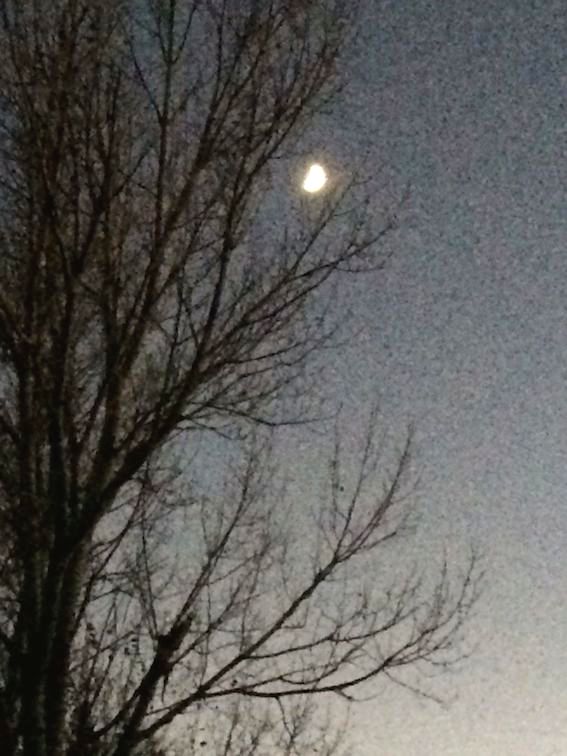
Fate of the Daogi, and others In my childhood, I used to hear at night the bird call: daok, daok. Low, intense cry. I slipped out of the bed to the hall, stared toward the dark wood. No bird call, but a light swam in the black lake of the night forest. Trees vanished into the new houses. I heard Daogi no more. Light swam in the dark lake of the night. ©Byung A. Fallgren
Poetry
Old year you must not…
from The Death of the Old Year, the poem by Alfred, Lord Tennyson "Old year you must not go; So long you have been with us, Such joy as you have seen with us, Old year you shall not go." As I was reading The Death of the Old Year, by Tennyson, I was attracted especially by the above stanza of the poem. With what has been happening in the world, I'd feel quite the opposite; I am glad to say goodby to the old year. Maybe, I'm not alone. However, I was stricken by the tenderness and warmth of the old poet's view. And I thought: why not? (Alfred Tennyson was born on August 6, 1809, in England, died on October 6, 1892. Many of his poems are among the best known in the English language.)
The Strange Woman
The Strange Woman
How I learned for the first time of the
impureness of the world. (From the memory
of my childhood.)
My early child home, the thatched, rural house
at the foothill, sometimes attracts wayfarer for
the overnight sojourn. So, when a middle-aged woman,
heavy set, sat on the edge of the entrance hall
with my mother, I thought, another one.
This one didn't go to the guest room near the gate,
gabbing low, stealing my mother's sewing hour.
Part of her story I heard was:
some say the bell is made of animal hide.
no one knows where it is, but it sounds
deep and sonorous. It only tolls at midnight.
Although it is somewhere in the city where
I live, you can hear it here if you listen hard.
My mother nodded; didn't seem to believe the woman.
At the age seven, I was doubtful.
I must go home to the city now, the woman said,
peeking in her bag. I have no money to ride a bus.
If you spare me some...
My mother gave her bus fee.
This is not enough, the woman demanded.
I don't have money, my mother told her.
The woman paused. What about the hidden one?
Furrowing her brows, my mother said, what money?
The one in the drawer, the woman said, her voice rising.
Tell that girl to bring it here, all of it. I'll take the half.
At the sudden turn of the woman's behavior,
my mother and I, alone in the house, were shaken.
What's hidden in her bag? How does she know
the money in the drawer, our life for the month?
Mother told me to bring the money.
All of it, the woman chimed.
I hurried to the drawer in the room, took one half of the money
to my mother, which she gave the other half of it to the woman.
I know this is not all, the woman said to me. Go get all of it.
That is all we have, I lied.
Don't lie. the woman said.
I don't. I was angry at the rudeness of the woman.
Did you get all the money? my mother asked me under her breath.
Yes.
She's lying, the woman said.
That is all we have, I lied again.
The woman took the money and left.
I feared, my mother said. the woman might harm us.
Blame the remote house. Naked and vulnerable.
Or the strange woman, I thought. She taught me the world
is not as pink and safe as I think; and that
I wouldn't become a part of it; angry no more.
Now, I wonder if the child of me had seen the woman
as more than just a robber, for I felt a gossamer of
sympathy for her, amused a bit by her story.
Like this world, good and bad, with many possibilities.
©Byung A. Fallgren
The Warden & the coyote
The Warden & the Coyote from the conversation between my parents I eavesdropped as a child My father loved his tiny office, his new world: the old wooden desk, the rickety chair; his new job as a warden; low pay but better than the old job, police officer. The solitariness, the pine trees, trees; the meditating woods; the silence; they mind their own business; don't bother to know what the new warden is like; if he's square but sane and righteous guy. One afternoon, returning to his office from the routine work, checking round the woods, my father found a coyote in the chair, with a smug smile. It resembled to the sly one he'd seen at the old police station. He winced at the dark memory; filthy as the frothy sea waves. What are you doing here? He frowned. Just checking on you. Coyote narrowed an eye, still smiling. In this remote place, you could get killed and no one would know. Ha. Why you care? Father stepped on the cigarette butt. I know why you are here. He took a bill out of his pants pocket and toss it to the animal. Go buy yourself a little bite and don't come back! The coyote grabbed the crumpled bill, the warden's precious daily allowance, and jeered, see you later, warden. My father's eyes trailed the skunk between the trees. In his mind, image of him drifted away in the red wind. He shook his head; not this time. (Note: in this poem, the coyote is used as a symbol of self-inviting, sly man who used his tactic to take people's money.) ©Byung A. Fallgren
The Man Whose Voice has been taken from his Throat
The Man whose Voice Has been Taken from His Throat Naomi Shihab Nye--1952 remain all supple hands and gesture skin of langue fusing its finest seam in fluent light with a raised finger dance of lips each sentence complete he speaks to the shadow of leaves strung tissue paper snipped into delicate flags on which side of the conversation did anyone begin? wearing two skins the brilliant question mark of Mexico stands on its head like an answer
At the Arts & Crafts store before Christmas
At the Arts & Crafts store before Christmas hustle and bustle of the people to buy the ornaments as if wishing the magic tree colorful balls crammed in the clear bag look at the shoppers, wondering if rainbow spirit is finally blooming at the artificial flowers' shelves blooming four seasons arranged neat and gorgeous with absence of scents like empty beauty pageant ©Byung A. Fallgren
Moment of the Sun in the Shadow
Moment of the Sun in the Shadow When we don't see the negative appearance of within, the reason for being narsistic or be wild goer, while the cells shrink. The reflection in the mirror or still water points to what we miss to see; how we correct the wrong; the mind, the real us; where the dark lake turns clear to mirror the blue sky and the clouds; where the snake can be morphed and born a sainthood; or the moment of the sun in the shadow; if only we could grab it safe, the gay youth, full of dreams, would've grown to reach the peak. ©Byung A. Fallgren Matthew Shepard, who was gay, died in October 1998 after two men beat him and left him tied to a fence on a plot of land outside Laramie, where he was attending the University of Wyoming. Today, a portrait honoring the life of Matthew Shepard is on display at the Washinton D.C.
Winter Blue Remedy Song
As a remedy we tend to
think of the ones shivering
in the cold, in the land near and far,
while the senile ones on the top
play the game of war.
Another winter blues, the one you can see
in the dying plants;
in the tears of a mother;
in the shudder of the moon; remedy
yet to be found;
hidden in the bottom of
the conscience, gem in the rock;
wish it points to the light.
©Byung A. Fallgren

Night
The sister, one of the two fingers
The Sister, one of the two fingers Her eyes see things others don't when it comes to her bro. when she catches his post on the Facebook about his past surgery as if recent one and his worry on the hospital bill, her senses go purple alert; halt her impulse to send him a check, give her mom a call to make sure if he'd do that. Mom says it must be a hacker. she'd call her brother for sure. Mom's heart blooms: she knew two fingers are better than one, like a nation needs ally. --Byung A.